ScenarioForge ingests your Jira, Linear, Azure DevOps, GitHub, GitLab or YouTrack tickets and produces reviewable scenarios, executable test cases, and Confluence docs — running on your infra, with your LLM credential.
By the time a ticket is groomed, the engineer is already typing. The QA lead, meanwhile, is still translating "the overdraft logic changed" into 80 scenarios, 30 edge cases, and a Confluence page no one will read.
ScenarioForge runs that translation in your VPC, against the LLM your security team already cleared, and hands you a reviewable artifact — not a black box. Reviewers stay in the loop; the writer pushes only what's been approved.
You can stop after step 2 and review forever. You can re-run step 3 with a different writer. You can re-publish step 4 without duplicating Confluence pages. ScenarioForge is idempotent end-to-end.
Connect Jira, Linear, Azure DevOps, GitHub Issues, GitLab Issues, or YouTrack. ScenarioForge reads the requirement and any linked context (acceptance criteria, attached specs, parent epics).
Your LLM credential generates a reviewable bundle: scenarios, executable test cases, coverage map, and an RTM stub. Streamed in chunks; cancellable mid-run.
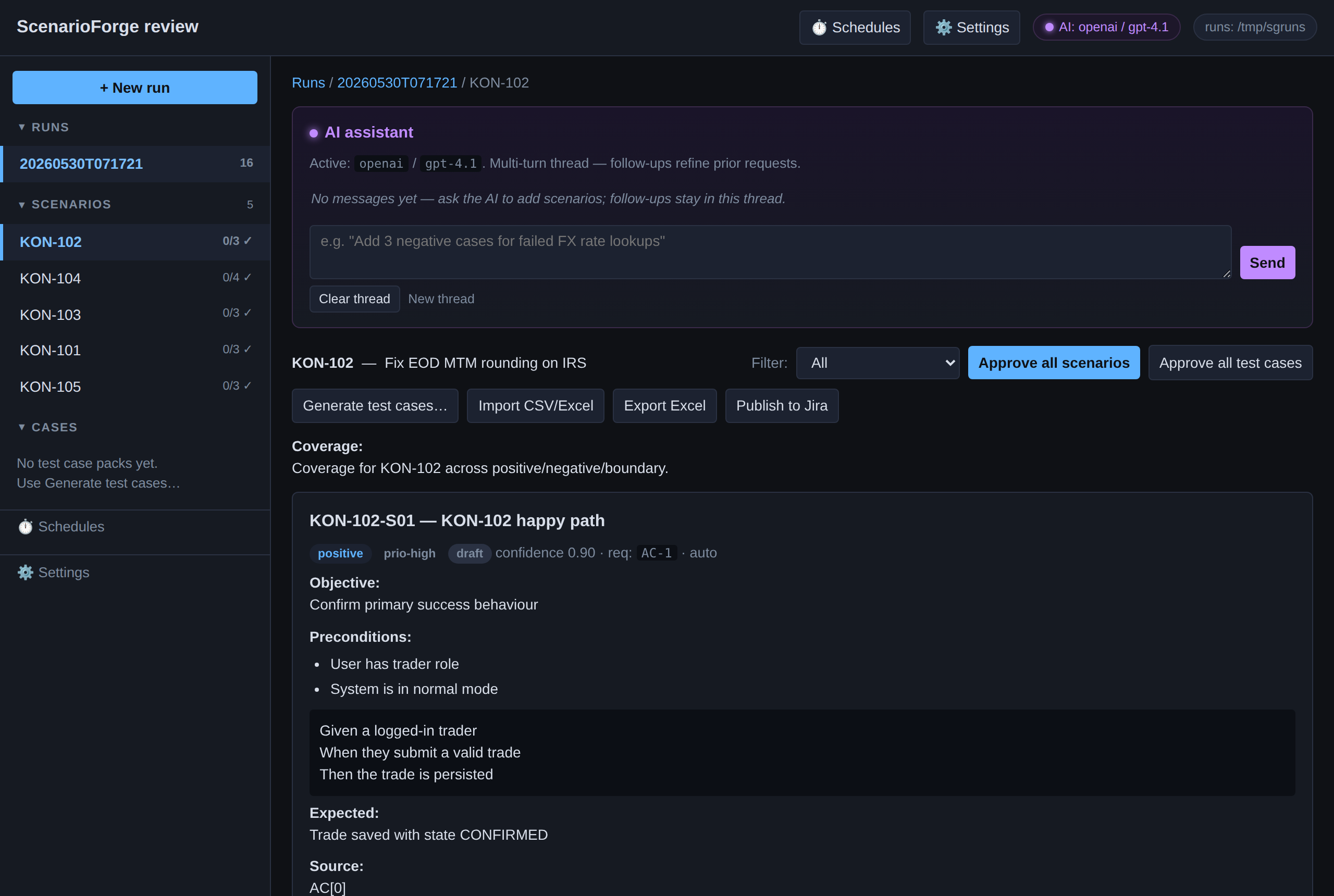
Reviewers triage, edit, or reject tests. Diff against the source ticket lives in the same view. Nothing leaves the reviewer's hands until they approve it.
Back to your tracker (four writer modes, including Xray and Epic → Story → Sub-task hierarchy). Forward to Confluence as per-bundle pages plus an RTM page. Re-publishes are idempotent.
Same ingest → review → push flow regardless of which tracker your customer happens to be on. If you sell consulting, this is what lets you say "yes" to whatever they use.
Cloud + Server + Data Center. Ingest by JQL.
Ingest by team, view, or label. OAuth or PAT.
Ingest by query, area path, or iteration.
Ingest by repo + label. Projects v2 supported.
Ingest by group, milestone, or label.
Ingest by saved search. JetBrains-shop friendly.
Three promises. No icons, no infographics — just the contract.
We don't proxy your prompts. The OpenAI / Azure / Bedrock / Anthropic / Gemini / vLLM credential lives in your container's secret store and goes straight from your VPC to the provider you chose. Token spend hits your provider account, not ours. There is no token margin to extract.
Self-host via Docker or Helm. Run in your VPC. Pair with a self-hosted OpenAI-compatible LLM and the system is air-gap-ready. The licence is offline-verifiable (Ed25519). No phone-home, no anonymous telemetry, no "anonymised metrics".
Every action — ingest, generate, review, push, login, role change — lands as a structured JSON record under <state>/auth/. Per-tenant or install-wide. Export for SOC 2. Diff against an arbitrary date range.
Every tier includes the full ingest → review → push flow on your LLM credential. The difference is tenants, seats, trackers, and the depth of the support contract.
Marco's pattern: spin up Studio once, white-label it, hand one tenant to each client. Their users, their settings, their LLM keys, their runs, their audit logs — nothing leaks across the divider.
The dashboard reads branding.yaml per tenant: product name, header colour, logo, footer. ScenarioForge stays out of your customer's eye line.
Full breakdown — including how we lose — available on request: hello@orbaos.com. Names redacted per their trademark policies; pricing ranges come from analyst reports + public RFP responses.
| ScenarioForge | Tricentis | Functionize | Curiosity | |
|---|---|---|---|---|
| Self-host | ✓ | ✓ / ✗ | ✗ | ✗ |
| BYOK LLM | ✓ | ✗ | ✗ | partial |
| Multi-tracker (6+) | ✓ | partial | ✗ | partial |
| Multi-tenant | ✓ | ✗ | ✗ | ✗ |
| Annual mid-tier | $12 — 36k | $80 — 250k | $60 — 180k | $40 — 120k |
Mid-tier list as of 2026 H1. Pricing is opaque on the competitor side — these ranges come from analyst reports and public RFP responses, not paid disclosures.
Eight of them. The first one is BYOK. Of course it is.
vLLM, LM Studio, or a Bedrock VPC endpoint — and ScenarioForge runs with no outbound network access.comment on the source ticket, native Test (the built-in Jira test issue type), Xray, or Epic → Story → Sub-task hierarchy. The writer dropdown lives in the Push dialog on the run page; the mode is also configurable per-tenant.comment and sub-issue; ADO gets Test Case work item; etc).One Docker command and a branding.yaml. Point it at your tracker and your LLM credential. Cancel any time — there's nothing to cancel; it's running on your hardware.
docker pull ghcr.io/luigipascal/scenariogen:enterprise-edge